
Agentic context engineering governs what an AI agent can read and do by controlling prompts, repository rules, tools, memory, external data, and message history.
It governs the selection, assembly, provenance, and execution of that context, so the agent receives task-relevant knowledge with clear ownership and traceable decisions.
If your coding agent reads the wrong repository rule, stale architecture note, or untrusted tool response, the failure may appear as bad code.
The root cause sits earlier: the entire context entered the run without ownership, provenance, or a testable policy.
I use context engineering to answer a practical question: what should this agent know for this task, and why should you trust that knowledge?
In this guide, you will learn:
- What does context engineering mean for coding and delivery agents?
- How do agents fail when context is unmanaged?
- How to build a context inventory before adding more memory?
- How does the five-step context governance loop work?
Key insights
- A short prompt can still fail when the agent receives stale rules, noisy retrieval, or untrusted tool output.
- Too much context in repository content can reduce agent performance when relevant information gets buried.
- Writable memory needs ownership, freshness checks, conflict detection, and rollback.
- Development-layer governance and runtime control solve different problems.
- Context drift creates maintenance and delivery risk long before a model visibly fails.
What is context engineering for AI agents?
Context engineering for AI agents is a system for deciding which detailed knowledge reaches an agent, in what form, and under which controls.
That knowledge includes instructions, repository files, tools, MCP descriptions, external data, and message history.
Anthropic describes agent context as a combination of system instructions, tools, MCP, external data, and conversation history. Its guidance favors the smallest high-signal token set rather than indiscriminate accumulation.
Read its effective context engineering for AI agents' guidance for the broader model.
A working definition for coding and delivery agents
For a coding agent, context engineering starts with the task and works backward.
You identify the constraints, select the repository knowledge that applies, assemble it into a readable sequence, and record what the agent changed or learned.
The output is a governed input package with provenance, not merely a longer prompt.
A useful context package can include a repository rule, a testing convention, a service boundary, a migration template, and a known failure pattern.
Each item needs a reason to exist. If nobody can explain that reason, the item is probably context debt.
The difference between knowledge selection, context assembly, and execution
These three stages are easy to blur, but they create different failure modes. Knowing which stage a problem sits in tells you where to fix it, instead of patching the symptom in the diff.
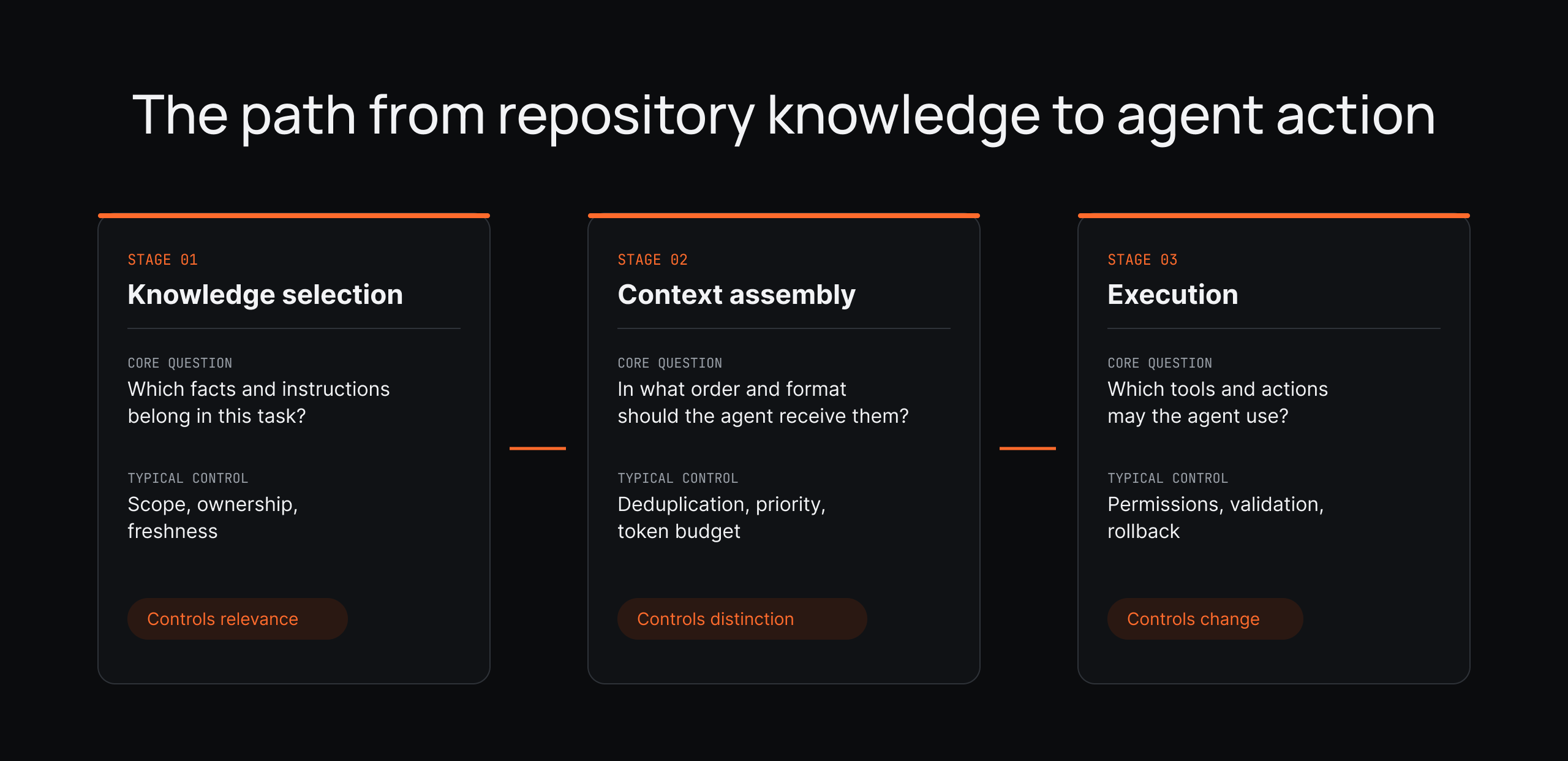
Selection controls relevance.
Assembly controls what the model can distinguish.
Execution controls what the agent can change.
Context engineering governs the path from repository knowledge to agent action, instead of treating prompt construction as an isolated writing task.
How do agents fail when context is unmanaged?
Unmanaged context rarely fails with one dramatic error.
More often, the agent produces plausible work while quietly ignoring a constraint, repeating a stale pattern, or trusting content that should have been treated as hostile.
That makes diagnosis expensive.
A review finds a symptom in the diff, while the real cause sits in retrieval, ordering, or memory mutation.
Compare these failure modes against the Top 4 AI Governance Challenges in Production.
Context collapse and the brevity bias
Long context creates a strange failure mode: the agent has access to the answer but behaves as if it does not.
The Lost in the Middle study, submitted July 6, 2023, and revised November 20, 2023, found significant degradation when relevant information appeared in the middle of long contexts. The model may favor instructions near the beginning or end.
A repository rule placed between generated logs and tool output can lose practical influence, even when the agent technically received it.
I treat placement as part of governance.
High-impact constraints need explicit priority, predictable assembly, and tests that verify the agent follows them.
Iterative rewriting that erodes details
Agents often summarize their own history. Each rewrite removes details that appear redundant, including the exception that mattered.
Anthropic discusses compaction and note-taking as techniques for managing long-running agent work in its September 2025 engineering guidance.
The operational question is what survives compaction, who owns that summary, and whether you can restore the previous version.
A memory update should look like a reviewed change, not an invisible overwrite. Store the source, timestamp, author, task, and superseded version.
Grep the whole repo and the cost of irrelevant information
Indiscriminate retrieval creates noise before the agent writes a single line. Generated files, old migrations, vendor code, and unrelated services can compete with the active boundary.
The LongFuncEval study, published April 30, 2025, measured performance drops of 7%–85% as the number of tools increased.
It also measured 7%–91% degradation as tool-response length increased and 13%–40% degradation as multi-turn conversations grew.
Those figures concern function-calling evaluations, not your repository directly. They still show why context budgets need explicit design rather than unlimited retrieval.
When irrelevant information enters the context, review time rises because you must distinguish agent reasoning errors from assembly errors.
How to build a context inventory before adding more memory?
Build a context inventory by listing everything your agents already read before you add another memory store.
Most teams discover several overlapping instruction systems: repository files, system prompts, skill definitions, generated summaries, tool descriptions, and conversation history.
Record each item’s location, purpose, audience, owner, sensitivity, update path, and removal criteria.
It should also identify whether the content is authoritative, advisory, or untrusted.
Check where your team sits in the AI Governance Maturity Model.
System prompts, repository rules, skills, templates, and lessons learned
Treat each context type as a different artifact:
- System prompts define broad behavior.
- Repository rules define local engineering constraints.
- Skills describe repeatable procedures.
- Templates shape output.
- Lessons learned capture past failures, but they decay fastest.
Coding-agent tooling increasingly supports repository-owned instruction files as an official way to carry project context. The GitHub repository instructions documentation shows one place that context can live.
I recommend assigning every artifact a scope and a removal condition. “Useful someday” is not a scope.
Trust boundaries for tools, MCP descriptions, and external data
Tool descriptions are instructions with operational consequences.
MCP’s tools specification defines model-invokable capabilities with schemas and annotations, so descriptions and permissions belong in your review surface.
See the MCP tools specification dated June 18, 2025.
External content needs a trust label before it enters context.
Documentation, tickets, logs, and web pages can contain text that attempts to redirect the agent.
OWASP recognizes prompt injection and related risks as application-security concerns for large language model systems, including risks from untrusted content entering model context.
The OWASP Top 10 for Large Language Model Applications provides the relevant security framing.
See how those boundaries support SOC 2 and HIPAA in AI Governance Compliance: How to Keep AI-Generated Code Secure and Compliant (SOC 2, HIPAA).
A context inventory turns hidden assumptions into reviewable artifacts with owners, boundaries, and removal rules.
How to govern agent context in 5 steps?
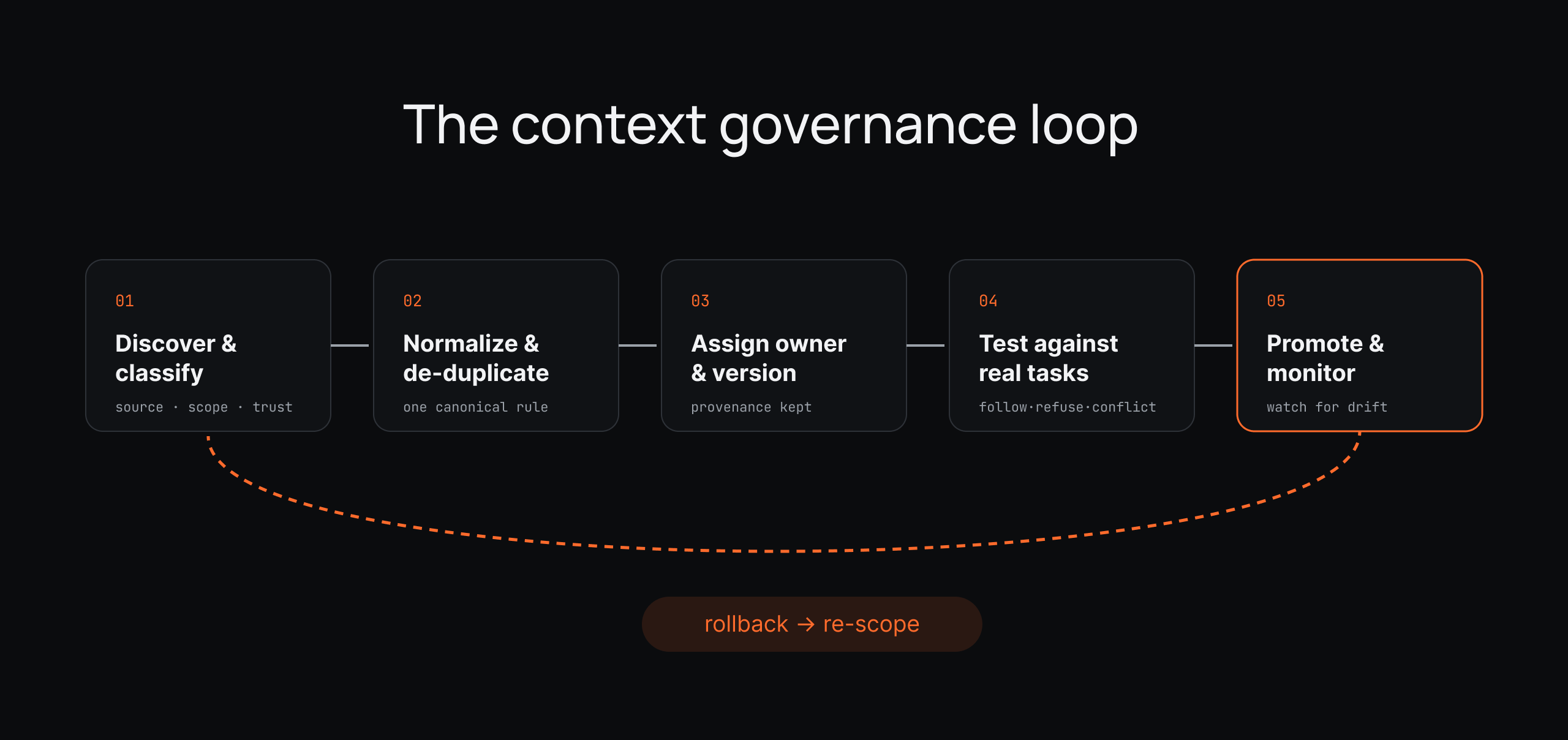
Treat context changes like code changes: discover them, review them, test them, and roll them back when they fail.
The loop starts with discovery and ends with monitored promotion or rollback.
I separate development-layer context from runtime context here.
Repository-owned rules and lessons need version control.
Runtime data may need request-level filtering, authorization, and retention controls.
1. Discover and classify knowledge
Start by collecting every input an agent can read or invoke.
Classify each item by source, scope, sensitivity, authority, freshness, and trust.
Ask whether the agent needs the item for all tasks, one service, one workflow, or one incident.
Broad scope should require stronger evidence because a broad context can influence more changes.
2. Normalize and de-duplicate
Two rules that say nearly the same thing will eventually diverge.
Normalize terminology, convert repeated instructions into one canonical artifact, and link references instead of copying paragraphs.
Deduplication is not cosmetic.
It reduces conflict during assembly and gives reviewers one place to change a rule.
3. Assign ownership and version changes
Every context artifact needs an owner who can approve edits and retire stale guidance.
Store changes beside the code or in a repository with comparable review history.
A writable memory item should carry provenance: source task, author, evidence, timestamp, confidence, and superseded version.
Without that record, a useful lesson can become an untraceable command.
4. Test against representative tasks and edge cases
Test context with normal work and adversarial cases.
Include a complex task that should follow the rule, one that should refuse an unsafe shortcut, and one where two artifacts conflict.
Measure the findings that matter: selected files, tool calls, rejected actions, test outcomes, and final diff quality.
DORA’s 2024 report preview found only 24% of respondents trusted AI-generated code “a lot” or “a great deal,” according to DORA’s August 2024 report preview.
Trust requires observable checks, not confident prose.
5. Promote, monitor, and roll back
Promote a context change only after it passes representative tasks.
Monitor for drift through failed tests, review comments, repeated corrections, and unexpected tool use.
See which signals to track in AI Agent Observability: How to Make Autonomous Agents Auditable.
Rollback must be ordinary.
If a new rule increases failures, restore the previous version, record the reason, and reopen the change with a narrower scope.
The governance loop makes context change behave like an engineering change: discover it, review it, test it, monitor it, and roll it back when findings deteriorate.
How to keep the evolving context safe?
Context evolves because your codebase evolves.
Services move, deployment rules change, and an exception that mattered during one migration becomes harmful after the migration ends.
The risk grows when agents can write memory without a structured change path.
Silent mutation hides drift until the next task depends on it.
Structured delta updates instead of silent rewrites
A delta update states what changed, why it changed, which evidence supports it, and which prior guidance it replaces.
Keep the old version available.
For example, a lesson can say that a specific test fixture fails under a particular migration path.
It should not become a broad instruction to avoid the entire testing pattern.
Use a schema for memory updates.
Fields might include scope, source, owner, created date, expiry, confidence, and rollback reference.
The schema turns memory from prose into a reviewable artifact.
Conflict detection, freshness checks, and approval policy
Conflict detection should run before an update becomes available to agents.
Compare new guidance with existing rules, ownership boundaries, and tool permissions.
Freshness checks should flag artifacts past their review interval or tied to removed code.
Approval policy should vary by impact.
A formatting template can receive a lighter review than a rule that permits database writes.
NIST’s AI Risk Management Framework calls for governance, measurement, and management across the AI lifecycle, rather than relying only on model behavior.
The NIST AI RMF 1.0, published January 26, 2023, supports that operational approach.
Safe context evolution depends on visible deltas, explicit conflicts, and a rollback path that works before production pressure arrives.
Which tool helps govern context engineering?
The tool you want sits at the development layer, where context originates: in the repository, next to the code. It should make rules, memory, and review artifacts versioned and reviewable.
Atlas is one such control plane. It is the AI governance solution for shipping production software as a governed system. Three pillars, one methodology, any infrastructure you can defend. See the GitHub repo.
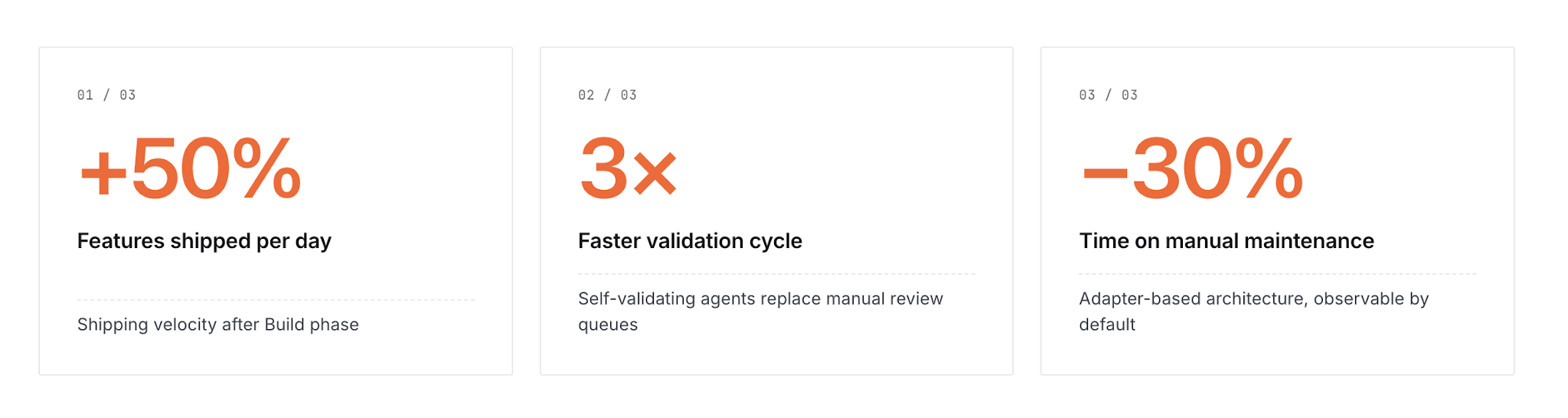
Teams use Atlas to target outcomes like +50% features shipped per day, 3x faster validation cycles, and -30% time on manual maintenance, depending on workflow maturity and adoption. The payoff is directional, not a guaranteed benchmark.
Weigh it against other layers in the AI Governance Tools Comparison.
What does Atlas make reviewable in the repository?
Atlas makes context changes part of the repository conversation.
Your team can review whether a rule belongs at the repository, service, or task scope; whether a lesson duplicates existing guidance; and whether a template still matches current code.
The practical benefit is traceability.
When an agent makes a surprising change, you can inspect the context artifacts it received and the versions behind them.
This also supports drift control.
Stale guidance becomes a repository finding rather than an invisible instruction embedded in a prompt or memory store.
What remains the responsibility of runtime systems?
Runtime systems still own request-time context.
They decide whether a caller may access data, which tenant boundaries apply, and which tools can execute an action.
They also handle runtime secrets, external data freshness, policy enforcement, and production observability.
Repository governance cannot authorize a payment or validate a live customer record.
Think of the boundary plainly: Atlas governs the development knowledge agents read while changing your codebase.
Runtime systems govern live information and actions.
Atlas Core makes development context reviewable without pretending that repository governance controls every runtime decision.
To sum up: Where to start with context engineering?
Context engineering for AI agents starts with an inventory, not another memory layer.
Identify what your agents read, classify its authority and trust, then govern changes through ownership, versioning, testing, and rollback.
The goal is a smaller, clearer context package that supports the task without hiding critical rules among irrelevant content.
Start with the development layer, where repository context can receive the same review discipline as code.
Ready to go beyond context? Start with the Complete Guide to Governed AI Engineering.
See how Atlas governs repository-owned context, or talk to Blazity about applying it to your stack.
FAQ on context engineering for AI agents
What is context engineering for AI agents?
It is the discipline of governing what knowledge an agent reads, in what order, and under which controls, rather than only wording a better prompt.
The scope spans selection, assembly, provenance, permissions, freshness, and validation across prompts, repository rules, tools, memory, and external data.
How does context engineering differ from prompt engineering?
Prompt engineering usually focuses on wording and instruction design, while context engineering governs the full input system around the agent.
That system includes retrieval, tool descriptions, repository artifacts, conversation history, trust boundaries, and change control.
Why is indiscriminate repository retrieval risky?
Indiscriminate retrieval increases noise and can bury relevant instructions among unrelated files and tool output.
It also makes failures harder to diagnose because you cannot easily tell whether the agent misunderstood the task or received poorly selected context.
Should agents be allowed to write their own memory?
Agents may propose memory updates, but those updates need provenance, ownership, review, freshness checks, and rollback.
Silent rewrites make stale or incorrect guidance difficult to detect.
Sources
- LongFuncEval: Measuring the effectiveness of long context models for function calling (April 30, 2025)
- DORA 2024 Report Preview: AI in the workplace: Adoption and impact (August 30, 2024)
- Lost in the Middle: How Language Models Use Long Contexts (November 20, 2023)
- Adding repository custom instructions for GitHub Copilot
- Effective context engineering for AI agents (September 29, 2025)
- OWASP Top 10 for Large Language Model Applications
- Artificial Intelligence Risk Management Framework 1.0 (January 26, 2023)
%201.svg)