


What it does?
What is the outcome?
Who is it for?
Building e-commerce platforms is hard. Building one with enterprise-grade features — crawling budget optimization, sub-second search across millions of products, sophisticated faceting, and perfect performance scores — is significantly harder than implementing a headless CMS.
Most templates work fine for small and medium businesses. But the demands of enterprise e-commerce — SEO at scale, conversion-optimized browsing journeys, fast builds regardless of catalog size — are beyond what existing projects deliver.
Enterprise Commerce exists because we needed a template that treats performance as a revenue lever, not an afterthought.
A monolithic commerce platform will never match the speed of a fast-lookup system like Algolia or Constructor. Even with aggressive caching, the combinatorics of search terms, filters, and sort options create endless unique queries. A fast source-of-truth is table stakes for a fast browsing experience.
Enterprise Commerce separates concerns: Shopify manages product data and transactions. Algolia handles search, faceting, filtering, and recommendations. Next.js renders the storefront with carefully chosen strategies per page type.
The result: instant navigation between pages. Sub-second filtering across entire catalogs. Perfect Lighthouse scores without compromise.
Every page type uses a rendering strategy optimized for its specific role in the conversion funnel:
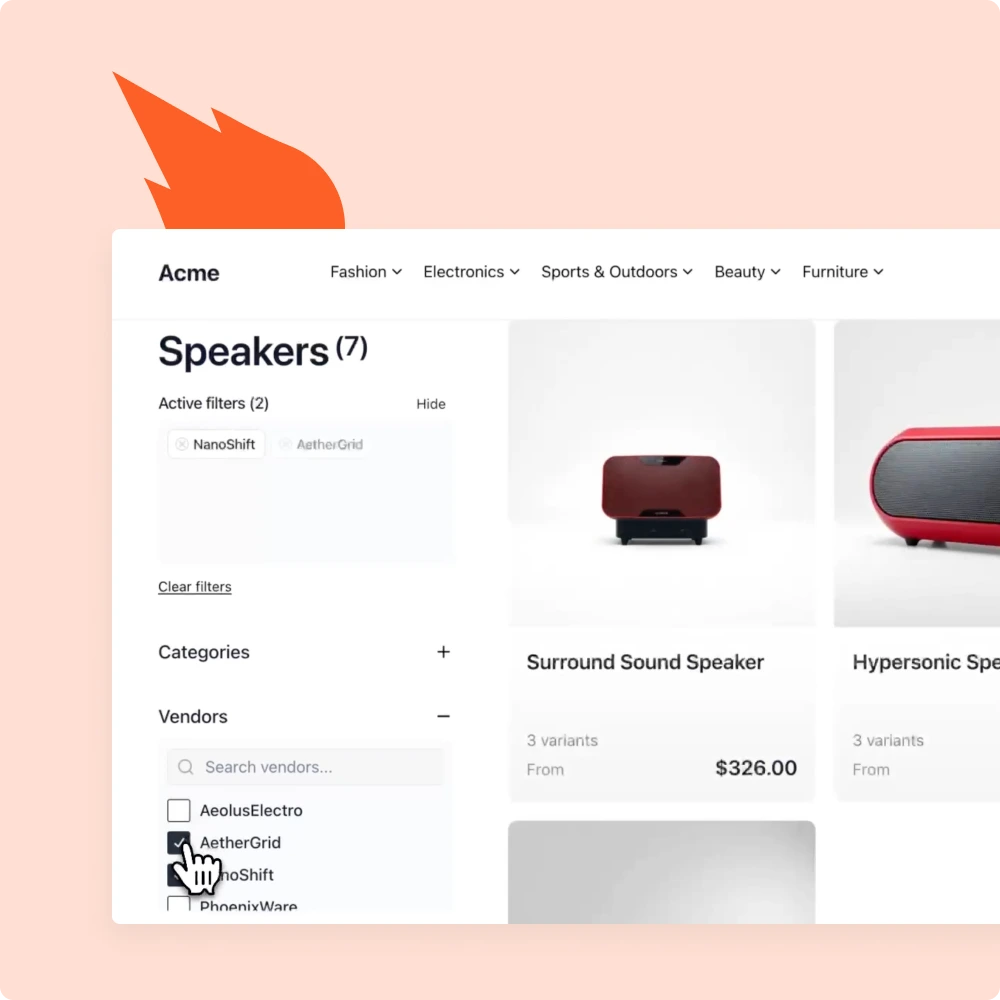
Search is powered by Algolia, giving you typo tolerance, word similarity matching, and instant results across thousands (or millions) of products. Faceting supports multiple simultaneous filters — product content, average rating, vendor, variants like color, and min/max price — all with sub-second response times.
Pagination is intentionally traditional. No infinite scroll. No fancy loading animations. Just battle-tested, fast, and predictable navigation that works at enterprise scale.
Step 1: Deploy to Vercel
Click the one-click deploy button to create your own instance. The template sets up the full Next.js storefront with all page types and routing configured.
Step 2: Connect Shopify
Link your Shopify store as the e-commerce backend. Product data, categories, and transaction handling flow from Shopify into the storefront.
Step 3: Configure Algolia
Set up Algolia as your search and faceting layer. Product data syncs automatically, giving you instant search, filtering, and recommendations across your entire catalog.
Step 4: Customize & launch
Adjust the design (built with v0), configure your categories and page types, and deploy. Full documentation available at docs.blazity.com/enterprise-commerce.
Enterprise Commerce is the storefront template we wished existed when building e-commerce for enterprise clients. Every decision — from rendering strategies to pagination to SEO architecture — comes from real experience building revenue-critical storefronts where performance directly impacts conversion.
670+ GitHub stars. 130+ forks. 7 contributors. Built by the same team that delivers 70% performance improvements and maintains zero regressions across 18+ months for enterprise clients.

Test our OSS libraries, check our partners, talk to our clients—before you commit.

100% Next.js. Enterprise-grade. Frontend, infrastructure, architecture.

Engineers who think like owners. Proactive, accountable, quality-obsessed.

We build your capability, not your dependency.