

A free 10-chapter guide to fixing slow bundles, API calls, and caching. Master SSR, SSG, and Core Web Vitals — and ship the snappy experience your users expect.
Battle-tested SSR, SSG, ISR, and code splitting patterns that cut load times without rewrites.
Pinpoint the bundle bloat, slow APIs, and caching misses that silently drain conversions.
Pick the right model — SSR, CSR, ISR, SSG, Server Components, or streaming — for each route.
Concrete tactics to move LCP, INP, and CLS into the green — and translate metrics into revenue.
Every major performance lever covered in depth — from code splitting to Core Web Vitals.
Pages of actionable content
Chapters, zero filler
Rendering strategies explained
Core Web Vitals covered
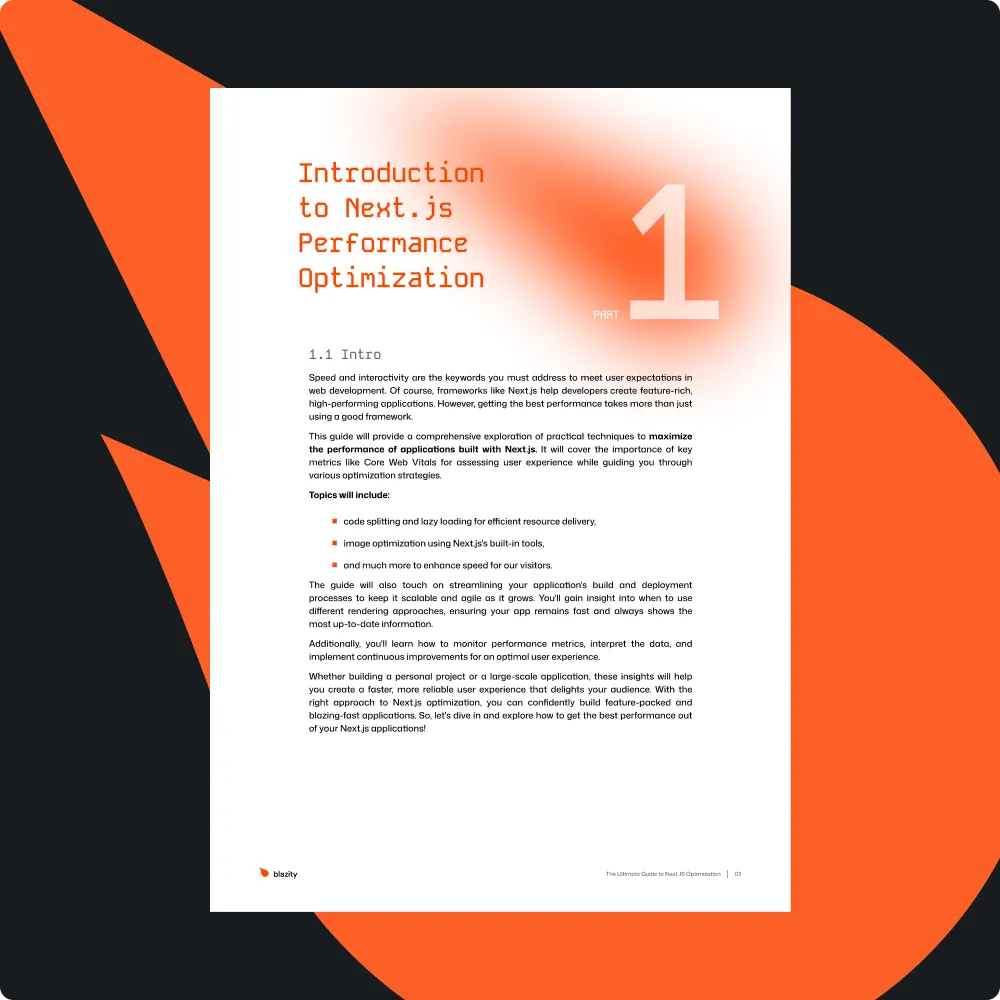

Senior frontend developers, tech leads, and engineering managers working with Next.js in production — particularly those responsible for performance at scale in ecommerce, SaaS, and content-heavy platforms. If you're deciding between rendering strategies, chasing Core Web Vitals scores, or trying to keep performance from degrading as your app grows, this guide is written for you.
You'll get deep, implementation-level coverage of code splitting with next/dynamic, progressive and selective hydration, Next/Image optimization, third-party script strategies, font loading, and the full spectrum of rendering approaches — SSR, SSG, ISR, CSR, Server Components, and streaming. Plus concrete guidance on Core Web Vitals (LCP, INP, CLS), performance budgets, and the monitoring stack used to keep production apps fast.
This isn't a recycled list of "use a CDN and compress your images." It's a 109-page, Next.js-specific playbook written by engineers who contribute to the Next.js open-source ecosystem and ship enterprise-scale apps for a living. Every chapter combines the "why" (architectural trade-offs) with the "how" (code examples, config, tooling) — so you understand when to reach for each technique, not just that it exists.
Yes. The guide covers both routers — App Router rendering strategies (Server Components, streaming, Suspense) get dedicated treatment, and Pages Router patterns (getServerSideProps, getStaticProps, ISR) are covered with equal depth. You'll learn when each approach makes sense, not just how to use whichever one you started with.