

AI governance is the set of policies, access controls, and technical safeguards that determine how your organization builds, deploys, and monitors AI systems in production.
It covers who can act on an agent's behalf, what data it touches, and whether its decisions leave a trace. The AI governance challenges that break production systems rarely show up in a model card.
They show up in shadow tool usage, runaway token bills, ungoverned pull requests, and logs nobody kept.
This post breaks down the four governance failures we see most often in production AI systems and the specific controls that fix them.
In this guide, you will learn:
- what the four AI governance challenges look like in production,
- the business cost behind shadow AI, runaway cost and slop, ungoverned workflow, and missing audit trails,
- how to solve each data governance challenge with concrete controls,
- how Atlas ties the four challenges into one governed substrate.
Key insights
- According to IBM's 2025 Cost of a Data Breach Report, 97% of organizations with an AI-related security incident lacked proper AI access controls.
- Gartner's June 2025 press release puts the failure rate at over 40%: agentic AI projects will be canceled by the end of 2027 due to escalating costs and unclear ROI.
- Veracode's 2025 GenAI Code Security Report found that 45% of AI-generated code samples failed security tests across more than 100 LLMs.
- The EU AI Act's implementation timeline puts the remainder of the Act, including high-risk system obligations, fully applicable from August 2, 2026.
What are the biggest AI governance challenges in production?
Four failure patterns account for almost every AI governance incident we've diagnosed in production systems.
Each starts small, an unapproved tool, an unmonitored budget, an ungoverned pull request, and compounds into a cost, security, or compliance problem months later.
These are exactly the failures that AI governance frameworks like NIST's AI Risk Management Framework and OECD's AI principles are designed to prevent.
For the complete framework behind these fixes, read AI Governance Solutions: The Complete Guide to Governed AI Engineering.
Challenge 1: knowledge and context governance
Most production AI agents usually don't fail because the AI model itself is poor. Instead, failures often happen when there’s no clear oversight of what context the agent can access or where that context originates from.
Learn how to build and govern that substrate in Agentic Context Engineering: How to Govern the Knowledge Your AI Agents Read.
According to UpGuard's State of Shadow AI report, 81% of employees report using AI tools that were never approved by their organization. So do 88% of security leaders.
Menlo Security's August 2025 report puts free-tier AI tool use through personal accounts at 68% of employees. Of those, 57% admit to inputting sensitive data.
Your governance policy never sanctioned that context, but your team is accountable for the decisions it feeds.
How to govern the context your agents read?
The fix is a managed context substrate the agent reads from, not a prompt copied between projects.
Atlas Core holds that substrate: repo memory, rules, skills, templates, and review artifacts, versioned in the repo where the work happens.
Every agent reads the same governed context, so output stops drifting between people and projects.
Shadow AI stops being a problem once agents get governed access to the context they actually need.
Challenge 2: unmanaged AI cost and slop
AI cost overruns and code slop are the same governance failure wearing two faces: nobody set a budget, and nobody set a quality bar.
Gartner's June 2025 prediction puts the failure rate at over 40%. Agentic AI projects will be canceled by the end of 2027 because of escalating costs, unclear ROI, and inadequate risk controls.
According to MIT NANDA's July 2025 State of AI in Business report, about 95% of enterprise generative AI pilots fail to show measurable P&L impact.
Neither failure starts with the model. Both start with nobody tracking spend against outcome until the budget is gone.
The quality side is just as costly.
According to Veracode's September 2025 GenAI Code Security Report, 45% of AI-generated code samples failed security tests across more than 100 LLMs.
Ungoverned generation not only consumes tokens but also wastes engineering hours on cleaning up the agent's output.
How to put a budget and a quality bar on AI work
The fix is governed gates that stop slop before it merges, so spend tracks outcomes instead of raw volume.
Atlas runs those gates inside the workflow, checking cost and quality as agents work.
Internal Blazity benchmarks for Atlas point to -30% time on manual maintenance, +50% features shipped per day, and 3x faster validation cycles, depending on workflow maturity and adoption.
Unmanaged cost and unmanaged code quality are the same failure: nobody set a limit, and nobody checked the output before it shipped.
Challenge 3: ungoverned engineering workflow
Give an AI agent commit access and API keys without governing what it's allowed to touch. You've built a workflow nobody can defend in a security review.
According to IBM's 2025 Cost of a Data Breach Report, 97% of organizations with an AI-related security incident lacked proper AI access controls.
The same report found 63% of organizations still lack an AI governance policy altogether.
Keeping that workflow defensible under SOC 2 and HIPAA is covered in AI Governance Compliance: How to Keep AI-Generated Code Secure and Compliant (SOC 2, HIPAA).
Most teams that adopt AI coding agents skip straight to velocity gains. They never define who approves an agent's pull request, what repos it can touch, or what happens when it's wrong.
This is where engineering and governance teams usually clash. Velocity says ship it, governance says gate it, and most teams pick one instead of designing for both.
How to scope and gate every agent
Every agent needs an identity, a scope, and a human reviewer before it merges anything into production.
The fix is a defined path from ticket to pull request to governed merge, with machine-enforced gates at each step.
The Atlas Workflow pillar runs that path: agent execution inside the gates, human review at the boundaries.
Its methodology moves through four phases, Blueprint, Build, Handoff, and Monitor, so every change has an owner and a checkpoint before it ships.
See where your team sits on the path from vibe-coding to control in AI Governance Maturity Model: From Vibe-Coding to Governed Velocity.
Challenge 4: no observability or audit trail
When an AI agent does something wrong in production, the first question is usually the same: what did it do, and why? Without a log, there's no answer.
According to the EU AI Act's Article 16 obligations, providers of high-risk AI systems must keep automatically generated logs and maintain technical documentation. They must also pass a conformity assessment before market placement.
The European Commission's overview of the AI Act confirms the intent: logging of activity to ensure traceability of results.
This gap shows up in practice, too. Teams are building standalone tools just to capture tamper-evident evidence of what their coding agents did, because the platforms they already use don't log it by default.
NIST's AI Risk Management Framework structures this as a continuous cycle, not a one-time check: Govern, Map, Measure, Manage.
According to OECD's AI principles, more than 1,000 policy initiatives across over 70 jurisdictions now follow them. Nearly all are tied to model transparency and human oversight, not just risk scoring.
An audit trail earns its value during an incident: it's the only way to run a root-cause analysis instead of guessing.
How to log every agent action
The fix is an observable, adapter-based architecture that records every agent action as audit evidence.
Here's the minimum a governed log entry needs to capture:
{ "agent_id": "agent-checkout-refactor-07", "timestamp": "2026-07-13T14:22:03Z", "actor": "agent", "action": "file_write", "target": "src/checkout/payment.ts", "tool_calls": ["read_file", "run_tests", "write_file"], "human_reviewer": "pending", "cost_usd": 0.42, "policy_version": "v3.2" }Without this structure, an alert can tell you something happened, but not what, why, or who's accountable for it.
Atlas runs quality gates, static, eval, and policy, with self-validation built into every agent, so problems surface on each change. The Monitor phase then watches live behavior and flags drift before it reaches production.
Learn how to make autonomous agents auditable in AI Agent Observability: How to Make Autonomous Agents Auditable.
No log, no root cause – and no root cause means every incident becomes a guess instead of a diagnosis.
How to solve AI governance challenges with Atlas?
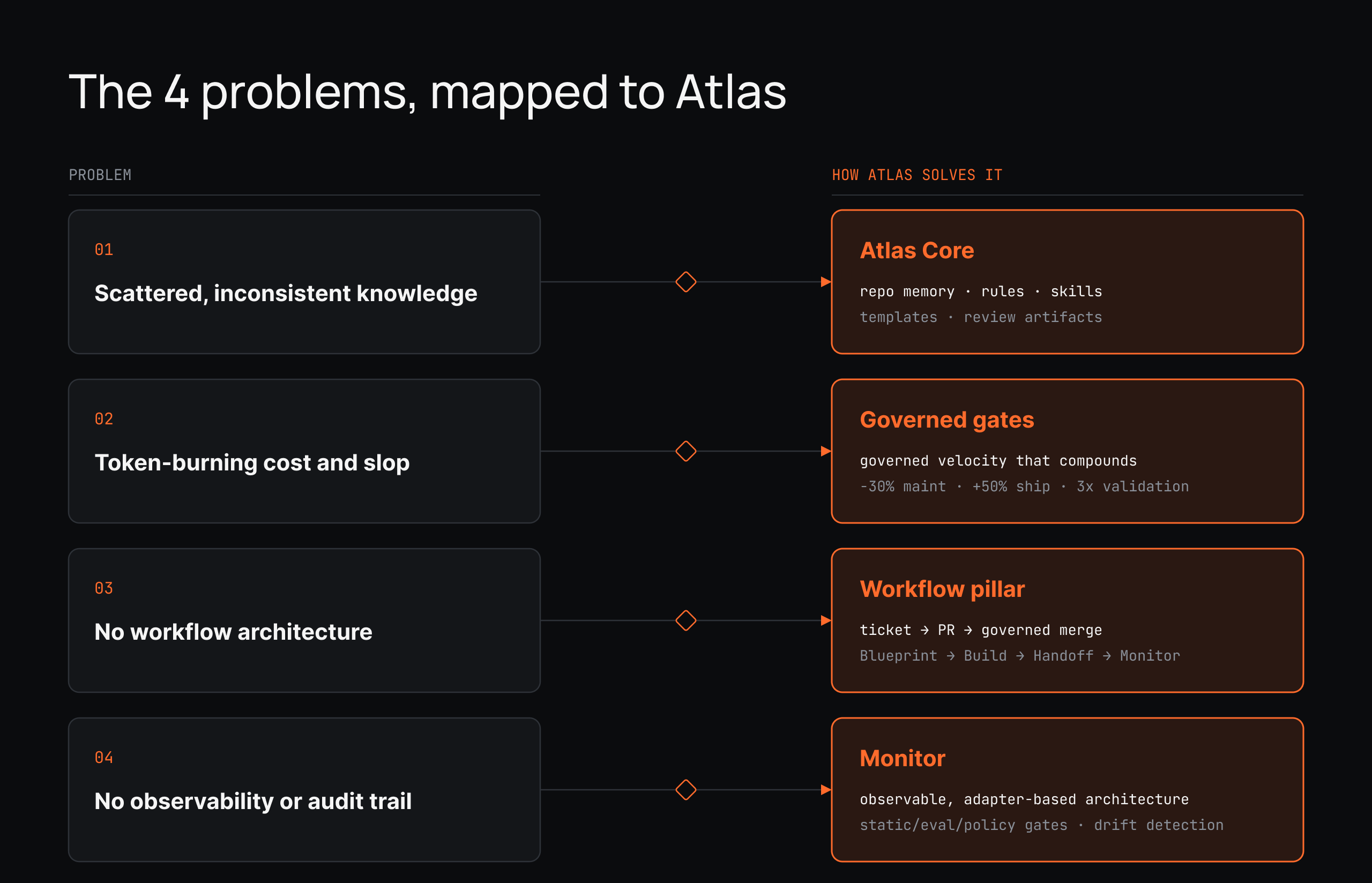
The four challenges above don't fail independently in production. Bad context governance leads to shadow tool usage, which leads to ungoverned cost, which leads to code nobody reviewed.
That leaves no audit trail when it breaks. Fixing one challenge with a point solution just moves the failure downstream.
Atlas is how we structure that instead of patching it challenge by challenge. It's the governed substrate underneath how we design production AI agents with governance and quality gates built in.
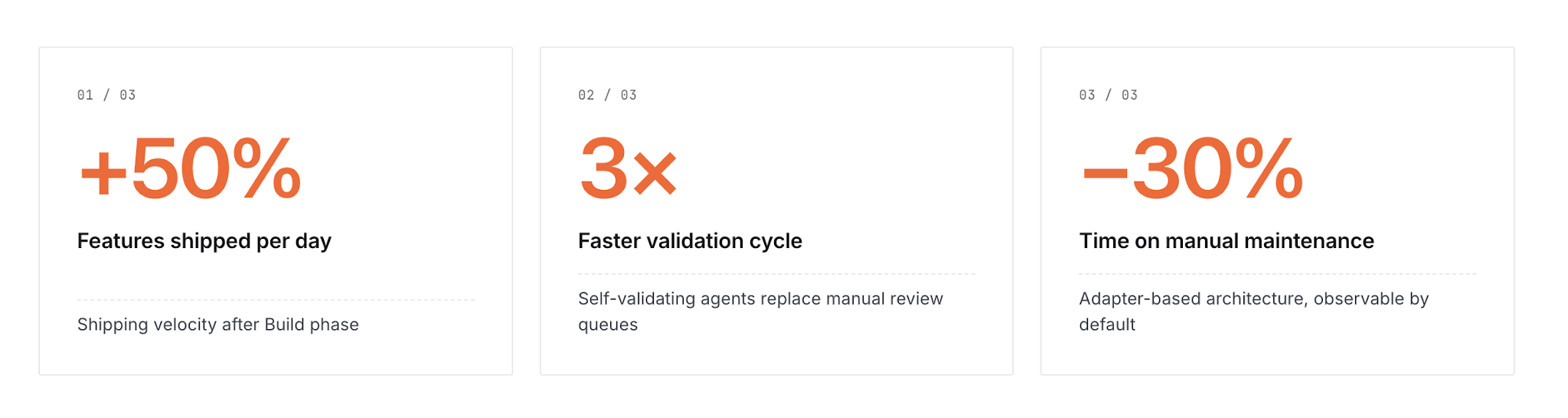
Teams use Atlas to target outcomes like +50% features shipped per day, 3x faster validation cycles, and -30% time on manual maintenance, depending on workflow maturity and adoption. The payoff is directional, not a guaranteed benchmark.
Every agent gets scoped API context, a defined budget and quality gate before code merges, a permissioned identity instead of a shared credential, and a log of every action it took.
We start most engagements with AI-augmented tech audits that catch coupling and complexity issues manual review misses.
From there, monitoring and observability dashboards with alerts give you continuous monitoring and the audit trail regulators and incident responders both need.
Point solutions patch one challenge at a time, a governed substrate closes the gaps between all four.
To sum up: How to get ahead of your AI governance challenges?
AI governance challenges don't resolve themselves as your agent fleet grows; they compound.
The organizations getting hurt by shadow AI, runaway cost, ungoverned commits, and missing audit trails aren't behind on AI adoption. They adopted first and governed later, which is the expensive order to do it in.
Reverse it. Map what your agents can access, set a cost ceiling before you set a roadmap, gate every pull request before you scale the team, and log every action from day one.
According to IBM's 2025 Cost of a Data Breach Report, the global average data breach now costs $4.4 million. Governing AI before it ships costs far less than the incident that forces you to start after the fact.
If you want a second opinion on where your setup stands, talk to an architect about your AI engineering setup.
FAQ on AI governance challenges
What is AI governance in production, as opposed to AI governance during development?
Development-time governance covers model selection and training data.
Production governance covers what happens after deployment: access control, cost limits, audit logging, and human oversight for live systems making real decisions.
Most AI governance frameworks, including NIST's AI Risk Management Framework, treat this as a continuous cycle rather than a one-time review.
How does the EU AI Act affect companies outside the EU?
The EU AI Act applies to any AI system used in the EU market, regardless of where the company is headquartered.
According to the EU AI Act's implementation timeline, the remaining obligations become fully applicable August 2, 2026.
If your AI system serves EU users, high-risk obligations under Article 16, including logging, technical documentation, and conformity assessment, apply to you too.
What's the difference between AI risk management and AI governance frameworks?
AI risk management identifies and scores specific risks, like a biased output or a runaway cost.
AI governance frameworks are the broader policy structure that assigns ownership, sets controls, and enforces them.
NIST's AI Risk Management Framework and OECD's AI principles both function as governance frameworks that risk management practices sit inside.
To see how specific platforms, frameworks, and toolkits stack up, compare them in AI Governance Tools Comparison (2026): Platforms, Frameworks, and Solutions.
How do you govern AI coding agents specifically?
Coding agents need the same four controls as any production AI system.
Those are scoped context access, a cost and quality ceiling, a permissioned identity with human oversight, and a logged action trail.
The difference is speed. A coding agent can open ten pull requests before a human notices a problem, so the gates need to be automatic, not manual.
What is shadow AI, and why is it a governance problem?
Shadow AI is any AI tool or model used inside your organization without approval, visibility, or a governance policy covering it.
According to UpGuard's State of Shadow AI report, over 80% of workers and nearly 90% of security professionals use unapproved AI tools.
It's a governance problem because you can't audit, secure, or budget for a tool you don't know exists.
Sources
- Cost of a Data Breach Report 2025 | IBM
- Article 16: Obligations of Providers of High-Risk AI Systems | EU Artificial Intelligence Act
- AI Act | Shaping Europe's digital future - European Union
- AI Risk Management Framework | NIST
- AI principles | OECD
- Insights from 2025 GenAI Code Security Report - Veracode
- The State of Shadow AI - UpGuard
- Gartner: Over 40% of Agentic AI Projects Will Be Canceled by End of 2027
- The GenAI Divide: State of AI in Business 2025 (MIT NANDA)
- Menlo Security's 2025 Report
%201.svg)