



Complete Next.js Migration for a Revenue-Critical Application
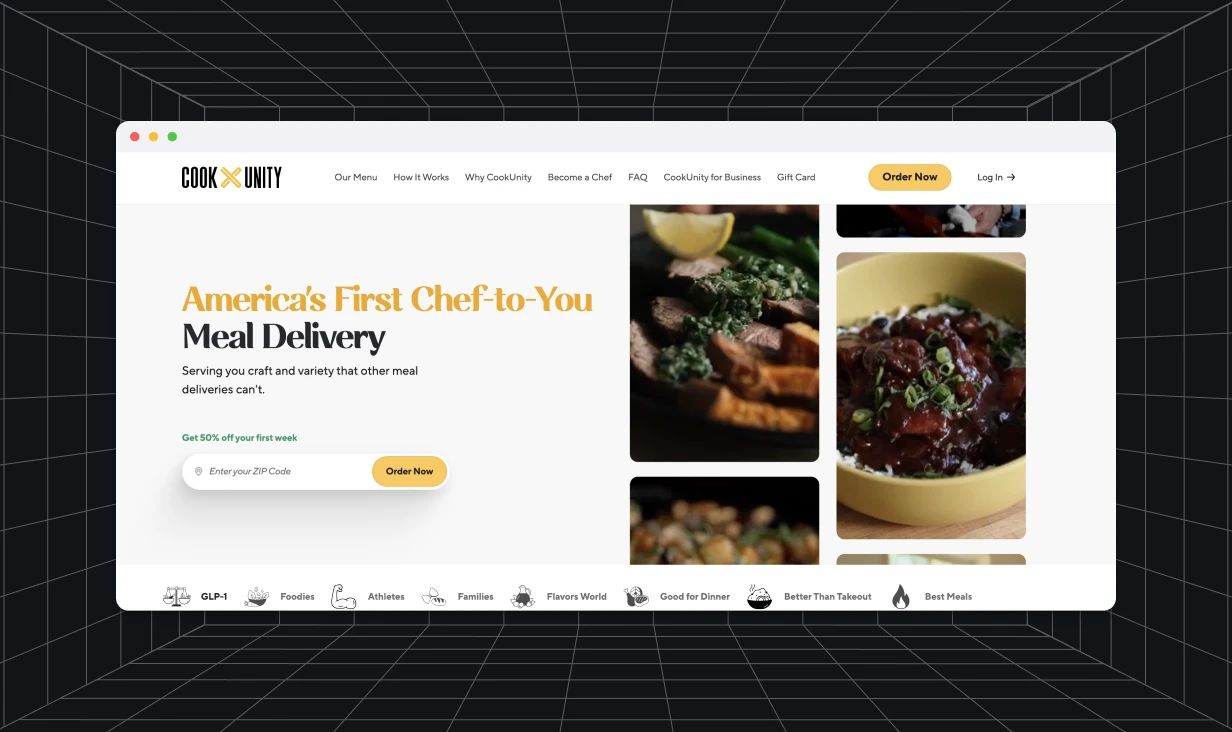
CookUnity's subscription funnel is the core revenue engine of the business. Performance wasn't a technical nice-to-have — it was a direct revenue lever. We executed a full migration from React.js with Redux to Next.js, optimizing not just code but architecture, infrastructure, and team processes to deliver sustained performance gains.
Pain Points
Every second of load time had a measurable impact on subscription conversion rates. The existing React.js and Redux implementation created compounding performance bottlenecks — heavy client-side bundle sizes, full-page re-renders on state changes, and a fully client-side rendered application that forced users to wait for JavaScript execution before seeing any meaningful content. Architectural constraints in the Redux state management layer made incremental optimization nearly impossible without a fundamental shift in approach.
Challenge
CookUnity needed more than incremental fixes. Their revenue-critical funnel demanded sub-second load times, but the existing client-side rendered stack had reached its performance ceiling. Any migration had to happen with zero downtime — the business couldn't afford even brief interruptions to its primary revenue channel. The new architecture also needed to be maintainable by CookUnity's internal team long after the engagement ended.
Solution
We executed a complete migration from React.js with Redux to Next.js in 3 months, using an incremental route-by-route cutover to maintain zero downtime throughout. The optimization focused on four layers:
- Application: Server-side rendering and selective hydration to eliminate render-blocking JavaScript. Dynamic imports and route-level code splitting to minimize initial bundle size. `next/image` for automated image optimization. LCP-focused optimizations across the entire subscription funnel.
- Architecture: ISR (Incremental Static Regeneration) with CDN-level caching and `stale-while-revalidate` headers. API route design optimized for Next.js data fetching patterns, replacing the heavy Redux client-side state with server-side data resolution.
- Capabilities: Team training on Next.js performance patterns. Lighthouse CI integrated into the development pipeline. Real User Monitoring (RUM) dashboards for continuous visibility into Core Web Vitals in production.
Engagement model: Dedicated project team, 3-month engagement, working alongside CookUnity's internal engineering team. As an official Vercel Partner, we brought direct access to platform-level optimization support.
Outcome
The migration delivered a 70% LCP improvement on the subscription funnel, bringing page loads into sub-second territory. Conversion rate improvements followed — the CookUnity engineering team reported that "every second has gigantic impact on revenue," and the performance gains translated into measurable business results sustained over 18+ months. Lighthouse CI in the deployment pipeline and RUM dashboards in production have maintained zero performance regressions since the engagement ended — proving that sustained results require optimizing the system, not just the code.